

Sandybook Tech Simplified - Please like, share & subscribe.


- Details
- Written by Sandybook
- Category: science
- Hits: 1114
Science Laws And Theories To Enhance Life
“I do not know what I may appear to the world, but to myself I seem to have been only like a boy playing on the sea-shore, and diverting myself in now and then finding a smoother pebble or a prettier shell than ordinary, whilst the great ocean of truth lay all undiscovered before me.”- Sir Isaac Newton, Memoirs of the Life, Writings, and Discoveries of Sir Isaac Newton
“I do not know what I may appear to the world, but to myself I seem to have been only like a boy playing on the sea-shore, and diverting myself in now and then finding a smoother pebble or a prettier shell than ordinary, whilst the great ocean of truth lay all undiscovered before me.”- Sir Isaac Newton, Memoirs of the Life, Writings, and Discoveries of Sir Isaac Newton
Let us see how we can apply the laws of science for greater success in our life:
Newton’s Law Of Universal Gravity :
The famous story that everyone has heard of is that Newton, the young scientist was sitting under an apple tree. Deep in contemplation, his reverie broke when he got hit on the head with an apple. In a flash of brilliant insight, Newton went “oh” or “yes” or some form thereof and discovered the law of gravity.
The real story is not too far from the truth. William Stukeley wrote the first biography of Newton called Memoirs of Sir Isaac Newton’s Life. Newton told the story of the apple to Stukeley who wrote in the biography:
“After dinner, the weather being warm, we went into the garden and drank thea, under the shade of some apple trees…he told me, he was just in the same situation, as when formerly, the notion of gravitation came into his mind. It was occasion’d by the fall of an apple, as he sat in contemplative mood. Why should that apple always descend perpendicularly to the ground, thought he to himself…”
The Law of Universal Gravitation states that any two objects in the universe attract each other with a force that is directly proportional to the product of their individual masses.
They also attract each other with a force inversely proportional to the square of distance between them.
What this means is that the larger the mass of the bodies, the more the force of attraction. The further apart they are from each other, the weaker the force between them.
How does this translate to our life and success?
You are attracted with a strong force and power to your largest goals and highest purpose.
The smaller and less ambitious your goals and purpose, the less enthusiasm and power you feel towards them. Tie your goals to a big picture or a dharma that most appeals to you, and you feel a strong attraction to it. When you do this, You feel enthusiastic, passionate and you come alive.
When you are far away from your goals or your big picture, you feel less attracted to them because of the distance. The closer your big picture is to your imagination and your real life, the stronger the pull towards it.
Make your dharma, purpose and big picture large enough and adventurous enough to feel a great power of attraction to them.
Keep the evidence of work towards your great goals close to your imagination and close to your actions.
Einstein’s Theory Of Special Relativity :
“The world as we have created it is a process of our thinking. It cannot be changed without changing our thinking.”― Albert Einstein
Einstein’s theory of relativity states that the laws of physics are the same everywhere in the universe. If you are on planet earth, you will observe the same laws of light and gravity as an object somewhere far away in space. Einstein introduced the idea of time and space continuum and that everything is relative.
“The universality of physics means that history is provincial. Different viewers will see the timing and spacing of events differently. What for us is a million years may just be a blink of an eye for someone flying in a high speed rocket or falling into a black hole.”
Einstein discovered special relativity by experiments that showed that the speed of light was constant when the earth orbited around the sun.
When applied to your success, this law translates to the idea that the laws of success are universal. This is true because with the correct systems and structures, anyone can become successful. Read that again!
This law also says that success, time and space are relative to the observer. Success is relative based on the beliefs and conditioning that you hold or the society that you are working in.
Some people believe that you need 10k hours to achieve mastery. This idea became popular by Malcolm Gladwell’s book Outliers. Others believe that it can be much shorter.
Success depends on the yardsticks and the frames of reference used to measure it.
Achieving success is universal like the speed of light. Anyone can achieve success if they work at it. However, the time and space and the measure of success is relative to your unique vantage point.
Time expands or shrinks based on what we are doing. Objects or projects feel heavier or burdensome or lighter based on your relative position on them. A successful attitude takes into account this changing time-space continuum and its relative nature.
“Your attitude, not your aptitude, will determine your altitude.” – Zig Ziglar
Newton’s Laws Of Motion :
“If I have seen further it is by standing on the shoulders of Giants.”― Isaac Newton
Newton’s laws of motion describe the relationship between an object and the different forces that act upon it. They also describe whether the object stays in rest or gets displaced or moves under the influence of the forces that act on it.
The three laws of motion were first compiled by Isaac Newton in his Philosophiæ Naturalis Principia Mathematica.
The first law is also the law of inertia. It states that every body maintains and continues its state of rest or of uniform motion until it is acted by an external force.
The second law states that force is in direct proportion to the mass of an object and its acceleration. The greater the mass of an object, the more force you need to increase its acceleration.
The third law states that for every action there is an equal and opposite reaction.
When applied, newton’s laws state that we are resistant to change when we are at rest or moving at a constant pace. We love to keep on doing or moving as we currently are and resist change.
Do you want to increase the speed of your motion or stop doing what you do not want to do? You need a force that acts to overcome this inertia.
Where can we find such forces that allow us to gather speed on paths that are suitable for success or slow us down on paths that we do not wish to be on?
- Find great mentors.
- Set up accountability partners.
- Create and participate in mastermind groups.
- Engage in personal power developing practices.
Also, become aware of the forces and the situations that are causing you to slow down or have inertia.
These could be:
- ealous coworkers
- Well meaning family and friends.
- Unsuitable work environment.
- Excess stress and tension.
- Lack of organization.
- Unclear or fuzzy steps forward.
The laws also state that mountains or big projects need greater force to move and need higher acceleration. The larger the project, the more the force and directed attention that you will have to impose upon it for success.
You may need to become aware of the “heaviness” of a project or a goal by:
- Breaking it up into small parts.
- Assessing how much time and effort you will have to give to each part.
- The understanding that huge projects are more difficult to act upon as a whole.
The third law answers itself and acts as a reminder of constant success.
Understand that every action that you take has an equal and opposite reaction. Now the reaction can allow you to move forward in your goals or take you a step backwards.
At the launch of a space rocket, the action of the powerful engines pushes the ground. This causes a huge reaction to launch the rocket into geostationary orbit or perhaps move it towards another planet.
In the same way, when you make a huge effort in the right direction, you will reap the benefits of your actions. You need to be continually assessing if you are moving in the right direction or not.
The Principles Of Enzymes, Substrates and Catalysts :
Enzymes are biological catalysts that increase the speed of a reaction. They also decrease the activation energy or the energy required for the reaction to proceed in the right direction.
The size of a cell is tiny at 15 to 25 microns. Most cells would not be able to provide the energy required for all the complex chemical reactions by themselves. Cells require chemical reaction assistance in the form of enzymes.
Enzymes provide this facilitation and enhancement. Enzymes alter the conformation of their active site to allow substrate or the reactants to fit together like a lock and key mechanism.
After they reduce the activation energy, enzymes help alter reactants into products. Thereafter, enzymes release products from the active site and return back to their original form.
This means that sometimes to be successful, we need the assistance of enzymes or catalysts.
These catalysts understand what the problem is and allow us to move forward. These life catalysts lower the resistance and energy required for projects and forward motion.
What are some example of catalysts in life?
- A collaborative and encouraging environment.
- Forming connections with other like-minded individuals.
- Having a great support system.
- Having a work space that fits individual ideas and ideals like a lock and key.
- Having optimal nutrition and exercise habits that work.
- Habits that enhance energy and lower the resistance or exhaustion.
- Having encouragers and bright side thinkers.
- Feedback and honest reviewers and reviews of work and success.
What catalysts do you have in your life to propel your success forward?
The Heisenberg Uncertainty Principle :
“The more precisely the position is determined, the less precisely the momentum is known in this instant, and vice versa.”–Heisenberg, Uncertainty paper, 1927
This one comes straight to us from Quantum Mechanics. This principle was discovered by Werner Heisenberg in 1927 at Niels Bohr’s institute in Copenhagen. Heisenberg received the nobel prize in Physics in 1932 for being one of the pioneers of the field of Quantum Mechanics.
Heisenberg was alone while Bohr was on a skiing holiday. He had the opportunity during this time to think about the nature of matter. It shocked him to have a clear realization that subatomic particles could change while someone observed them.
While measuring the tiny subatomic electrons, scientists used a measuring device in the form of light or radiation.
Electrons were so small and light that even the tiniest light energy altered their position and momentum.
Short but high energy wavelength light measured position well but threw off the momentum. Using low energy and longer wavelength light, the momentum would be more accurate but the position would be off.
The principle states that we cannot measure the position and the momentum of a particle with a high degree of precision. Since electrons around atoms are clouds of charge of tiny mass, their position and momentum is uncertain.
How is this principle applicable to our life and success?
You may want to control all the events of your plans and actions for a desired outcome. Even with great effort, there will still be uncertainty that you need to account for.
The best-laid plans are sometimes not the best option available. This is because the landscape of results changes constantly. Changes and results are full of uncertainty and you need to prepare yourself for that.
How do you prepare for uncertainty?
- Become all right with uncertainty.
- Train yourself to be comfortable with the discomfort of not knowing everything and taking small risks.
- Have alternate plans, paths and ideas if your original idea does not work out.
- Trying to keep everything balanced and firing on all cylinders may just not be possible and a setup for failure.
- Build in some uncertainty into your short term and long term planning.
Like the uncertainty principle but not the same is the observer effect in science. While uncertainty is inherent in systems, this is an imposed effect. The idea that observer biases can alter the state of an experiment and cause different results is the observer effect.
Different observers view results and progress in a different way. If you take feedback from one observer, it may not be favorable. Robust feedback includes several observers and taking the option that best suits you.
Evolution And Natural Selection :
“In the long history of humankind (and animal kind, too) those who learned to collaborate and improvise most effectively have prevailed.” -Charles Darwin
Theory of Evolution states that species change gradually over time. This change happens under the influence of the environment and selection pressures. The species best adapted to their environment are the ones likely to do better.
In 1831, a young Charles Darwin took up the position of a naturalist aboard the ship the HMS Beagle. He had a great interest in science, biology and geology and was a dedicated student of the natural world and a collector of insects.
Darwin arrived at the Galapagos Islands as part of his voyage. The richness of the local floor and fauna captured his attention. The islands located 965 kms off the coast of South America were too far for mainland species to colonize.
Darwin observed that even with the remoteness, life was abundant in the islands. Different islands also differed in life based on the location and the physical environment there.
How can we use the theory of Evolution to enhance life success?
One of the things inherent in life is change.
Everything is changing and in constant flux. Our minds and consciousness are also changing over time. If you can use this change as a vehicle for transformation, life becomes an exciting adventure.
One of the concepts that I love is the Japanese idea of Kaizen or constant and continuous change and improvement.
Now, we all know that success is not a straight line forward. It looks more like a curved and crooked circular path where we are going one step forward and sometimes one step backwards.
Hold an intention of forward and positive evolution of life and success.
Nature uses the principle of the survival of the fittest. The most vigorous and well-adapted species have a better chance in their survival.
The giraffes with the longer necks had a better chance of survival when compared to the ones with short necks when food ran out.
We can use this principle for greater success in our life. The idea is that the most fit and well adapted ideas and projects have the greatest survival chance.
Apply the idea of continuous improvement while adapting to a work place that is ever changing. This adaptation is a wonderful success strategy.
How can we adapt?
- Keep up with the trends in technology, social media and new ideas.
- Collaborate and improvise in an effective way.
- Be a life long learner and implementer of new ideas.
- Create ideas and processes that are adaptable and have a higher rate of success.
- Use small and quick improvements to make your products and projects better and better.
- The quickest, most efficient and the most value providing service will have a higher rate of survival.
“Every day, in every way, I’m getting better and better” -Émile Coué
- Details
- Written by Sandybook
- Category: science
- Hits: 2392
Important Laws of Physics
Physical laws are the conclusions drawn on the basis of long year scientific observations and experiments which are repeated again and again under different conditions to reach the assumptions which can be accepted worldwide. We all know our world works on some principles and these principles are drawn by our scientists in the form of certain physical laws. Let us discuss some important laws of physics which will enhance knowledge as well as help in the preparation of various entrance examinations.
Important Laws of Physics
- Archimedes Principle : The principle was discovered in 3rd century B.C. by the Greek mathematician. Archimedes. It states that when a body is partially or totally immersed in a fluid, it experiences an upward thrust equal to the weight of the fluid displaced by it that i.e. its apparent loss of weight is equal to the weight of liquid displaced.
- Avagadro’s Law : In 1811 it was discovered by an Italian Scientist Anedeos Avagadro. This law states that equal volume of all gases under the same conditions of temperature and pressure contain equal number of molecules.
- Ohm's Law : It states that the current passing through a conductor between two points is directly proportional to the potential difference across the two points provided the physical state and temperature etc. of the conductor does not change.
- Newton’s Laws (1642-1727) : Let us begin our explanation of how Newton changed our understanding of the Universe by enumerating his Three Laws of Motion.
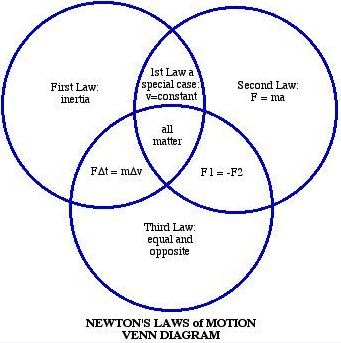
Law of Gravitation: Objects attract each other with a force directly proportional to the product of the masses of the objects and inversely proportional to the square of the distance between them. Hence, for objects on or near the earth, the mass of the earth is very much greater than the object, and so the gravitational force between them makes objects fall towards the earth. That is why lead and feather fall at the same rate in a vacuum.
-
Newton's First Law of Motion: Every object in a state of uniform motion tends to remain in that state of motion unless an external force is applied to it.
-
Newton's Second Law of Motion: The relationship between an object's mass m, its acceleration a, and the applied force F is F = ma. Acceleration and force are vectors (as indicated by their symbols being displayed in slant bold font); in this law the direction of the force vector is the same as the direction of the acceleration vector.
-
Newton's Third Law of Motion: For every action there is an equal and opposite reaction. This is the principle behind the recoil felt on pulling the trigger of a gun.
Newton’s Law of cooling
The rate at which a body cools or loses its heat to its surroundings is proportional to the excess of mean temperature of the body over that of the surroundings, provided this temperature excess is not too large.
5. Coulomb’s Law (1738-1806) : The force between the two electric charges reduces to a quarter of its former value when the distance between them is doubled. The SI unit of electric charge, coulomb, is named after Charles Augustin de Coulomb who established the law.
6. Stefan’s Law (1835-1883) : The total energy radiated from a black body is equal to the fourth power of its absolute temperature.
7. Pascal’s Law (1623-1662) : When pressure is applied to a fluid, the pressure change is transmitted to every part of the fluid without loss. Hydraulic machines like the hydraulic press work on this principle.
Atmospheric pressure decreases with increase in height. The SI unit of pressure is pascal which is named after Pascal who established this law.
8. Hooke’s Law (1635-1703) : This law states that the extension of a spring is proportional to the tension stretching it. Doubling of the tension results in the doubling of the amount of stretch.
9. Bernoulli's Principle : It states that as the speed of a moving fluid, liquid or gas, increases, the pressure within the fluid decreases. The aerodynamic lift on the wing of an aeroplane is also explained in part by this principle.
10. Boyles's Law : It states that temperature remaining constant, volume of a given mass of a gas varies inversely with the pressure of the gas.
11. Charles's Law : It states that pressure remaining constant, the volume of a given mass of gas increases or decreases by 1/273 part of its volume at 0 degree Celsius for each degree Celsius rise or fall of its temperature.
12. Kepler's Law : Each planet revolves round the Sun in an elliptical orbit with the Sun at one focus. The straight line joining the Sun and the planet sweeps out equal areas in equal intervals. The squares of the orbital periods of planets are proportional to the cubes of their mean distance from the Sun.
13. Law of conservation of energy : It states that energy can neither be created nor destroyed but it can be transformed from one form to another. Since energy cannot be created or destroyed, the amount of energy present in the universe is always remain constant.
14. Tyndall effect : The scattering of light by very small particles suspended in a gas or liquid.
15. Graham’s Law : It states that the rates of diffusion of gases are inversely proportional to the square roots of their densities under similar conditions of temperature and pressure.
- Details
- Written by Sandybook
- Category: science
- Hits: 1912
Chemistry in everyday life
“Chemistry is technically the study of matter, but I prefer to see it as the study of Change. Now just think about this: Electrons change their energy levels, molecules change their bonds, elements combine and change their compounds. Well, that’s all of life; right? It’s the constant, it’s the cycle. It’s solution, then dissolution, over and over and over. It is growth, then decay, then transformation! It is fascinating, really.”Read this article to get a hang of Chemistry in everyday life.Rings a bell? Yes, you are right. Walter White gives this amazing lecture to his class in the first season of Breaking Bad.
Chemistry is indeed in our everyday. You yourself are a big bag of chemicals! What is astonishing is the amount of applications we make of the gruelling formulae from our chemistry class in our everyday life. You find chemistry in daily life in the foods you eat, the air you breathe, cleaning chemicals, your emotions and literally every object you can see or touch. While some may be obvious, some other might surprise you. Let’s find out the Chemistry in our everyday life:
- Your body : Your body is mostly water which is hydrogen and oxygen. Almost 99% of the mass of the human body is made up of six elements: oxygen, carbon, hydrogen, nitrogen, calcium, and phosphorus. Only about 0.85% is composed of another five elements: potassium, sulphur, sodium, chlorine, and magnesium. All are necessary to life.
- Your emotions : The emotions that you feel are a result of chemical messengers, primarily neurotransmitters. Love, jealousy, envy, infatuation and infidelity all share a basis in chemistry. The sweaty palms and pounding heart of infatuation are caused by higher than normal levels of norepinepherine. Meanwhile, the ‘high’ of being in love is due to a rush of phenylethylamine and dopamine.
- Soaps and detergents : Everyday while washing our clothes we use soaps and detergents. These soaps and detergents are made of chemical ingredients. Soaps are sodium or potassium fatty acids salts, produced from the hydrolysis of fats in a chemical reaction called saponification. Each soap molecule has a long hydrocarbon chain, sometimes called its ‘tail’, with a carboxylate ‘head’. In water, the sodium or potassium ions float free, leaving a negatively-charged head. Soap is an excellent cleanser because of its ability to act as an emulsifying agent.An emulsifier is capable of dispersing one liquid into another immiscible liquid. This means that while oil (which attracts dirt) doesn’t naturally mix with water, soap can suspend oil/dirt in such a way that it can be removed.
- Onions : As harmless as they look, these when cut can make you cry rivers. There is a chemical reason behind this water. When you cut an onion, you break cells, releasing their contents. Amino acid sulfoxides form sulfenic acids. Enzymes that were kept separate now are free to mix with the sulfenic acids to produce propanethiol S-oxide, a volatile sulfur compound that wafts upward toward your eyes. This gas reacts with the water in your tears to form sulfuric acid. The sulfuric acid burns, stimulating your eyes to release more tears to wash the irritant away. Apparently, this water helps the dirt from your eye to wash away. One useful tip you can probably pass on to your mother is that if onion is cut under running water, most of the chemicals that make your eyes water get washed away. Voila!
-
Ice floats on water : If ice wouldn’t float, imagine the water of a lake freezing from the bottom! Chemistry holds the explanation for why ice floats, while most substances sink when they freeze. A water molecule is made from one oxygen atom and two hydrogen atoms, strongly joined to each other with covalent bonds. Water molecules are also attracted to each other by weaker chemical bonds (hydrogen bonds) between the positively-charged hydrogen atoms and the negatively-charged oxygen atoms of neighboring water molecules. As water cools below 4°C, the hydrogen bonds adjust to hold the negatively charged oxygen atoms apart. This produces a crystal lattice, which is commonly known as ‘ice’.
Ice floats because it is about 9% less dense than liquid water. In other words, ice takes up about 9% more space than water, so a liter of ice weighs less than a liter water. The heavier water displaces the lighter ice, so ice floats to the top. One consequence of this is that lakes and rivers freeze from top to bottom, allowing fish to survive even when the surface of a lake has frozen over. -
Sunscreen : We use sunscreen while going out in sun. Sunscreen uses chemistry to filter or block the sun’s harmful ultraviolet rays to protect you from a sunburn, skin cancer, or both. Do you know how sunscreen works or what an SPF rating really means? Sunscreen combines organic and inorganic chemicals to filter the light from the sun so that less of it reaches the deeper layers of your skin. Like a screen door, some light penetrates, but not as much as if the door wasn’t present. Sunblock, on the other hand, reflects or scatters the light away so that it doesn’t reach the skin at all.
The reflective particles in sunblocks usually consist of zinc oxide or titanium oxide. In the past, you could tell who was using a sunblock just by looking, because the sunblock whited out the skin. Not all modern sunblocks are visible because the oxide particles are smaller, though you can still find the traditional white zinc oxide. Sunscreens usually include sunblocks as part of their active ingredients. SPF stands for Sun Protection Factor.It’s a number that you can use to help determine how long you can stay in the sun before getting a sunburn. Since sunburns are caused by UV-B radiation, SPF does not indicate protection from UV-A, which can cause cancer and premature aging of the skin. Your skin has a natural SPF, partially determined by how much melanin you have, or how darkly pigmented your skin is. The SPF is a multiplication factor. If you can stay out in the sun 15 minutes before burning,using a sunscreen with an SPF of 10 would allow you to resist the burn for 10x longer or 150 minutes. Although the SPF only applies to UV-B, the labels of most products indicate if they offer broad spectrum protection, which is some indication of whether or not they work against UV-A radiation. The particles in sunblock reflect both UV-A and UV-B. - Bottled Water : Although bottled water has an expiration date, it doesn’t actually go bad. Why is there an expiration date on a product that doesn’t go bad? This is because all food and beverages, including water, have to carry an expiration date on its packaging to make it easier to standardize packaging. Some bottled water only carries its bottling date or a ‘best by’ date. These dates are helpful because the flavor of the water will change over time as it absorbs chemicals from its packaging. The flavour will not necessarily be bad, but it may be noticeable. Leaching of chemicals from packaging is a health concern, but as far as toxic chemicals go, you can get exposure to most of those chemicals from freshly bottled water as well as bottled water that has been on the shelf a while. A ‘plastic’ taste is not necessarily an indicator that the water is bad; absence of an unpleasant flavor does not mean the water is free from contaminants. While algae and bacteria will not grow in sealed bottled water, the situation changes once the seal has been broken. You should consume or discard water within 2 weeks after opening it.These are just some examples of how chemistry is almost in everything we are surrounded by. Imagine how intriguing it will be to divulge the chemistry that happens in the real world everyday instead of just the labs. Try to find some more chemistry behind the real world; you might surprise yourself.
We have 190 guests and no members online
भारत | Tech | General | Science | Space
मध्यकालीन इतिहास (Medieval History) | Valentine day quotes | Valentine Day animated Greetings |